
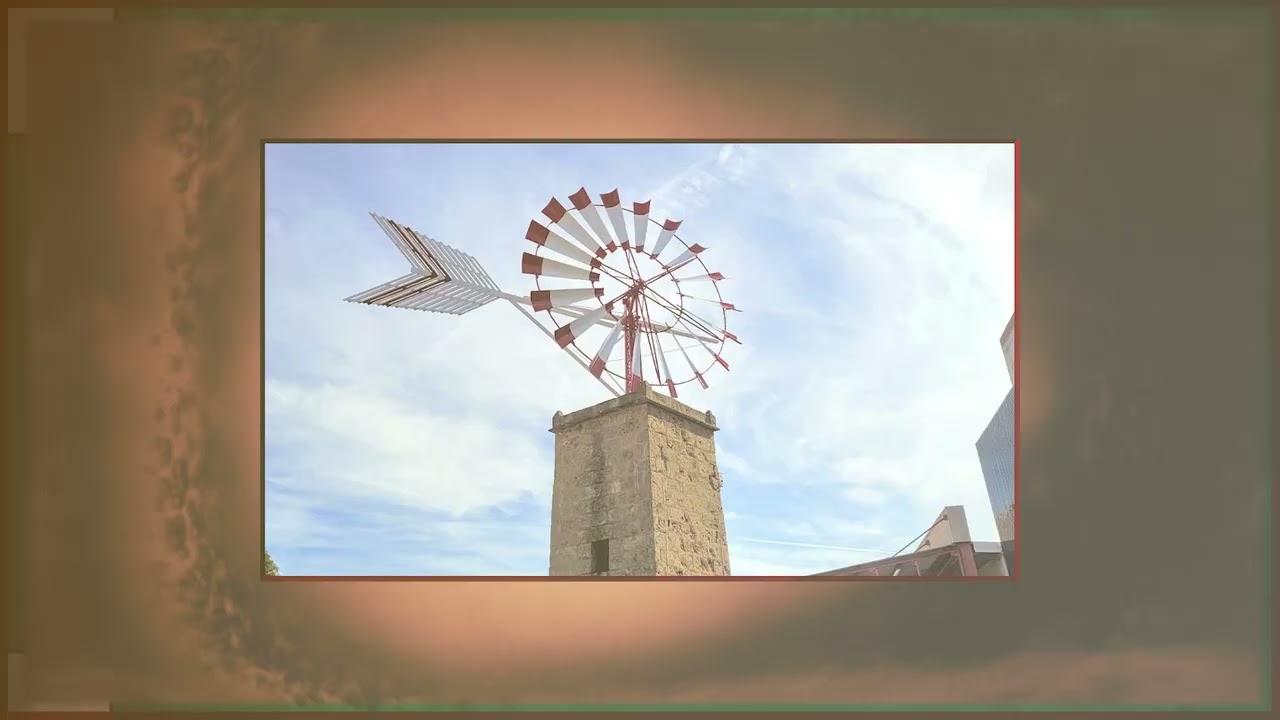

Aina Serrano is the coordinator of the Historical Industrial Heritage Unit at the Council of Mallorca. A historian by training, she has spent over two decades preserving mills, waterwheels and oil mills. Thanks to the investment of the Sustainable Tourism Tax, she has been able to promote projects that save heritage that is key to the island's identity from fading into oblivion.


How did you get started in the world of historical industrial heritage?
I am a history graduate and it was during the last years of my degree when I first came into contact with industrial heritage, researching the textile industry in the south of Mallorca. Shortly afterwards I joined the Council of Mallorca and, in 1999, I was already coordinating the catalogue of water-extraction windmills. Since then, my career has been completely linked to the conservation of this heritage.
How has the conservation approach evolved over the years?
In the beginning, work was only carried out on the mechanisms of the mills, without touching the architecture. But we realised that this was not sustainable. What was the point of restoring the mechanism if the tower was structurally cracked or in poor condition? Since 2004, we have been dealing with restorations in a comprehensive manner: architecture, mechanism and environment. Today, the programme includes windmills, animal-driven mills and watermills.
How important is training in this type of intervention?
It is absolutely essential. We run specialist courses on traditional architecture, wood pathologies, iron restoration and metal conservation. Continuous training enables us to work with the utmost rigour. Moreover, we work closely with craftsmen: masons, carpenters, blacksmiths. Without them, it would not be possible.
How is industrial heritage classified and what role do mills play in it?
I prefer to speak about historical industrial heritage because it includes both pre-industrial and industrial works. According to the law of the Balearic Islands, it includes everything linked to the past regarding technology, production and energy. Mills fit the bill perfectly. Windmills and watermills belong to the pre-industrial period, whereas those powered by coal or electricity belong to the industrial period. In both cases, they bear witness to how communities have adapted to the territory.
What types of mills can we find in Mallorca?
There are three main types depending on the source of energy:
Windmills: there are flour mills (for grinding grain) and water-extraction mills.
Watermills: they are powered by torrents or natural springs, despite the myth that there are no rivers here.
Animal-driven mills: these are moved by animal traction and were used to grind grain or even to grind paprika, such as the typical Tap de Cortí.
How many are currently listed?
We have identified some 2,500 water-extraction windmills, mainly concentrated in Palma, Campos, Sa Pobla, Muro and Ses Salines. We currently have 622 flour windmills listed throughout the island. In terms of the watermills, we estimate that around a hundred are still preserved, although not all of them are officially documented. The animal-driven mills are the most difficult to locate, as they are often integrated into private buildings.
What is their state of conservation?
Generally speaking, it is quite poor. Many mills are abandoned, others have been converted into housing, especially tower mills in urban areas. Water-extraction mills are usually isolated in the countryside and cannot be used as housing, so their condition is more delicate.
Are there still mills in operation?
Yes, although not many. Some farmers still use windmills for water extraction, especially in places where they do not have easy access to other sources of water. There are also animal-driven mills that could work if the owner has a draft animal, such as a mule or a donkey. However, in general, active use is very limited.
What role has the Sustainable Tourism Tax played in this conservation work?
Thanks to this funding, we have been able to carry out projects that would not have been possible otherwise. We have two lines of action: firstly, we provide technical staff and, secondly, we financially subsidise owners to carry out restorations under very strict criteria. Without this support, an important part of the heritage would be at serious risk.
Why is it so important to use traditional materials?
Because the mills are part of the traditional architecture, built using local materials: stone, wood, iron... Restoring them with any other materials would mean taking away their essence. What’s more, this practice is sustainable and promotes the local economy. I represent the Balearic Islands in the national plans for industrial heritage and traditional architecture, precisely where these criteria are defended.
Is there a visitor tour of restored mills?
Yes, we created one thanks to a European project. Even though the programme ended, we decided to keep the tour running. It currently includes 11 mills restored by our team, selected for their value, accessibility and state of conservation. There are flour windmills, water-extraction mills, and an animal-driven mill specialised in grinding paprika.
What future do you envision for this heritage?
It depends on several factors. On the one hand, it is essential that public subsidies continue to be available. But we also need the owners to get involved. Restoring a mill cannot be seen as a burden, but rather as an investment in identity and cultural value. Nevertheless, I am optimistic. There is a growing awareness of its importance.
What final message would you like to share?
Heritage is not only the past, it is also the present and the future. Every mill, every traditional part, holds a story that connects us to our roots. Restoring them is an act of respect for those who built them and an opportunity to pass on values to the generations to come. Heritage is identity, knowledge and opportunity.
News and Articles on Sustainable Tourism


